
Healthy Conflict Resolution:
Turning Disagreements into Deeper Connection
Contents
Why Healthy Conflict Resolution Matters
Every relationship—romantic, familial, or professional—will experience conflict. The question isn’t whether conflict occurs, but how it’s handled. Conflict can either deepen division or become a doorway to greater understanding.
In this post, we’ll explore:
- What conflict resolution really means
- Why healthy conflict resolution is important
- How it differs from typical conflict resolution
- What causes conflict in relationships
- How it helps relationships grow stronger
- What psychological frameworks are behind healthy conflict resolution
- How to start practicing healthy conflict resolution today
- Who can help you build these skills
Healthy conflict resolution is more than a skill—it’s a posture of humility, empathy, and courage that allows relationships to flourish even in disagreement.
What Is Conflict Resolution?
Conflict resolution refers to the process of navigating disagreements constructively so that both parties feel heard, respected, and valued.
According to the American Psychological Association (APA, 2021), effective conflict resolution involves emotional regulation, communication, and problem-solving skills—not just seeking compromise, but fostering understanding.
It’s not about who’s right or wrong; it’s about restoring connection.
“The goal of conflict resolution isn’t to erase tension but to transform it into dialogue.”
Marshall Rosenberg, Nonviolent Communication (2003)
Why Healthy Conflict Resolution Is Important
Unresolved conflict erodes emotional trust and safety. But when handled well, it actually strengthens relationships.
Research from the Journal of Family Psychology (Gottman & Levenson, 2000) found that couples who engage in open, empathetic conflict resolution report higher long-term satisfaction and emotional intimacy.
Healthy conflict resolution allows you to:
- Communicate without fear of judgment or dismissal.
- Repair emotional injuries quickly and authentically.
- Deepen empathy and perspective-taking.
- Reduce resentment and relational burnout.
The ability to resolve conflict well is one of the strongest predictors of relationship success—more than compatibility or shared interests.
Healthy vs. Normal Conflict Resolution
Many people think “conflict resolution” means simply ending the argument. But healthy conflict resolution is about emotional repair, not just peacekeeping.
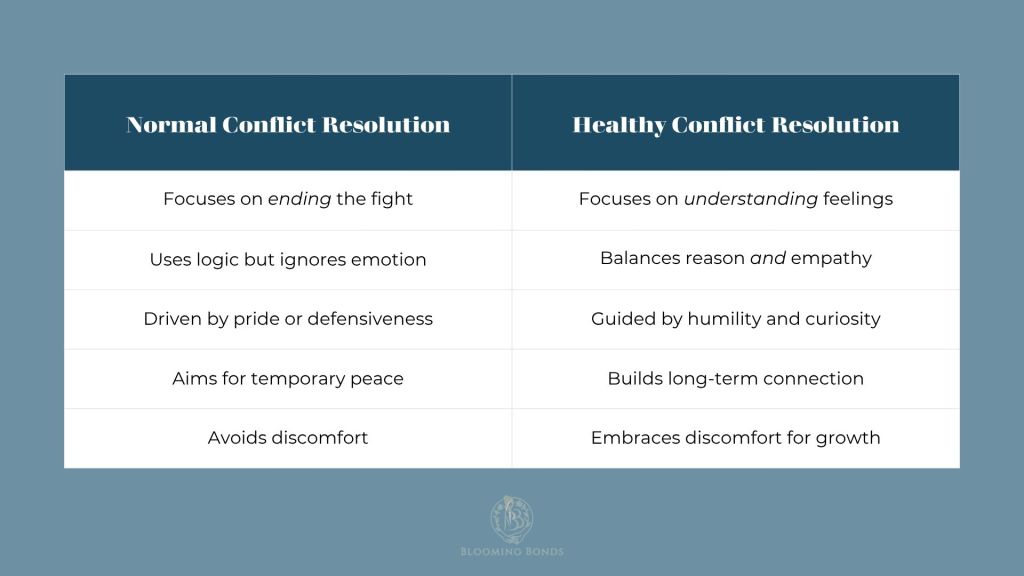
As Dr. John Gottman, founder of the Gottman Institute, emphasizes:
“Conflict is not a sign of a broken relationship—it’s a sign that two people are trying to make something work.”
Dr. John Gottman
Healthy conflict resolution turns conflict into a classroom for love.
Root Causes of Conflict in Relationships
Understanding why conflict happens helps prevent it from escalating. Common roots include:
1. Unmet Emotional Needs
When partners feel unseen, unheard, or unsupported, even small disagreements can trigger deep pain.
2. Communication Styles and Family Background
Family-of-origin patterns shape how we handle tension. Someone raised in a conflict-avoidant home may shut down, while another may escalate to feel heard.
3. Stress and External Pressures
Financial strain, parenting stress, or cultural differences can heighten reactivity and reduce empathy.
4. Attachment and Emotional Triggers
According to Attachment Theory (Bowlby, 1988), unresolved childhood insecurities can resurface during relational conflict—fueling fear of abandonment or rejection.
Healthy conflict resolution acknowledges these roots and invites curiosity rather than blame.
How Healthy Conflict Resolution Helps
Healthy conflict resolution doesn’t just solve problems—it transforms people.
1. Improves Emotional Regulation
Using practices from Dialectical Behavior Therapy (DBT), such as mindfulness and distress tolerance, helps individuals calm the nervous system before responding.
2. Encourages Empathy and Perspective-Taking
When partners learn to listen with empathy—what Dr. Brené Brown calls “believing others’ experiences”—they replace defensiveness with compassion.
3. Restores Safety After Conflict
Research by Dr. Sue Johnson (2008), founder of Emotionally Focused Therapy, shows that emotional safety is rebuilt when couples can repair ruptures through honest expression and comfort.
4. Promotes Long-Term Health
Chronic relational stress activates the body’s stress response. Studies reveal that couples who resolve conflict calmly show lower blood pressure and reduced cortisol levels.
5. Strengthens Spiritual and Relational Growth
In Christian relationships, conflict resolution becomes a reflection of grace. As Ephesians 4:2-3 teaches: “Be completely humble and gentle; be patient, bearing with one another in love.”
Healthy conflict resolution aligns emotional maturity with spiritual maturity.

Psychological Frameworks Behind Healthy Conflict Resolution
Understanding the science behind healthy conflict resolution gives you tools to manage it wisely.
- Polyvagal Theory (Porges, 2011):
Our nervous system shifts between safety, fight/flight, and shutdown. Calming the body before engaging helps restore connection. - Nonviolent Communication (Rosenberg, 2003):
Teaches individuals to express needs and feelings without blame, using language that promotes understanding. - The Gottman Method:
Encourages replacing the “Four Horsemen” (criticism, defensiveness, contempt, and stonewalling) with positive communication habits. - Emotionally Focused Therapy (EFT):
Focuses on repairing emotional bonds through vulnerability and responsiveness.
These frameworks show that conflict isn’t just an interpersonal problem—it’s an emotional, neurological, and relational process.
How to Practice Healthy Conflict Resolution
Here are evidence-based steps you can start using today:
- Pause Before Reacting.
Take a few deep breaths. Name what you’re feeling before you speak. - Use “I” Statements.
Replace “You never listen” with “I feel unheard when I try to share.” - Validate the Other Person’s Perspective.
Validation doesn’t mean agreement—it means empathy. - Identify Core Needs.
What are you really fighting for—respect, reassurance, safety, or control? - Seek Solutions Together.
Brainstorm with a mindset of “we,” not “me versus you.” - Repair Quickly.
Don’t let pride delay healing. Research shows that quick repair attempts predict long-term relational stability (Gottman, 1999). - Pray or Reflect Together.
For faith-based couples, ending a conflict with prayer or reflection invites humility and unity.
Who Can Help
Healthy conflict resolution is a learned skill—and sometimes, it helps to have guidance.
- Couples Therapy: Focuses on identifying patterns, emotional triggers, and repair strategies.
- Family Therapy: Ideal when intergenerational or communication issues fuel recurring tension.
- Relationship Coaching: Helps partners practice real-life application of healthy communication techniques.
- Christian Counseling: Integrates Biblical wisdom with psychological insight to promote healing through grace and empathy.
At Blooming Bonds, our therapists and coaches specialize in helping individuals and couples create emotionally safe, connected relationships built on trust and understanding.
Final Thoughts: Turn Conflict into Connection
Conflict doesn’t have to mean disconnection—it can be the catalyst for deeper love and growth. When handled with empathy and skill, conflict becomes a bridge, not a barrier.
If you’re ready to learn the proven tools and heart-centered practices that make this possible, we invite you to join our upcoming webinar:
In this interactive session, you’ll discover:
- How to manage emotional triggers with grace.
- Practical communication tools from leading relationship models.
- Real-world exercises to repair and reconnect after conflict.
Because healthy conflict resolution doesn’t just stop fights—it builds foundations of love that last.
References
- Branquinho, M., De La Fe Rodriguez-Muñoz, M., Maia, B. R., Marques, M., Matos, M., Osma, J., Moreno-Peral, P., Conejo-Cerón, S., Fonseca, A., & Vousoura, E. (2021). Effectiveness of psychological interventions in the treatment of perinatal depression: A systematic review of systematic reviews and meta-analyses. Journal of Affective Disorders, 291, 294–306. https://doi.org/10.1016/j.jad.2021.05.010
- O’Brien, J., Gregg, L., & Wittkowski, A. (2024). “Finding my voice again” – women’s experiences of psychological therapy in perinatal secondary care settings: a qualitative study. Frontiers in Psychiatry, 15. https://doi.org/10.3389/fpsyt.2024.1240855
- Kendall-Tackett, K. (2024). Treatment Advances in Perinatal Depression: Innovations and Promising Approaches. Journal of Clinical Medicine, 13(24), 7744. https://doi.org/10.3390/jcm13247744
- Howard, L. M., & Khalifeh, H. (2020). Perinatal mental health: a review of progress and challenges. World Psychiatry, 19(3), 313–327. https://doi.org/10.1002/wps.20769
- Sharma, G., Gaffey, A. E., Hameed, A., Kasparian, N. A., Mauricio, R., Marsh, E. B., Beck, D., Skowronski, J., Wolfe, D., & Levine, G. N. (2025). Optimizing psychological health across the perinatal period: An update on maternal cardiovascular health: A scientific statement from the American Heart Association. Journal of the American Heart Association. https://doi.org/10.1161/jaha.125.041369
- Singla, D. R., Silver, R. K., Vigod, S. N., Schoueri-Mychasiw, N., Kim, J. J., La Porte, L. M., Ravitz, P., Schiller, C. E., Lawson, A. S., Kiss, A., Hollon, S. D., Dennis, C., Berenbaum, T. S., Krohn, H. A., Gibori, J. E., Charlebois, J., Clark, D. M., Dalfen, A. K., Davis, W., . . . Meltzer-Brody, S. (2025). Task-sharing and telemedicine delivery of psychotherapy to treat perinatal depression: a pragmatic, noninferiority randomized trial. Nature Medicine. https://doi.org/10.1038/s41591-024-03482-w
Rice, C., Ingram, E., & O’Mahen, H. (2022). A qualitative study of the impact of peer support on women’s mental health treatment experiences during the perinatal period. BMC Pregnancy and Childbirth, 22(1). https://doi.org/10.1186/s12884-022-04959-7